

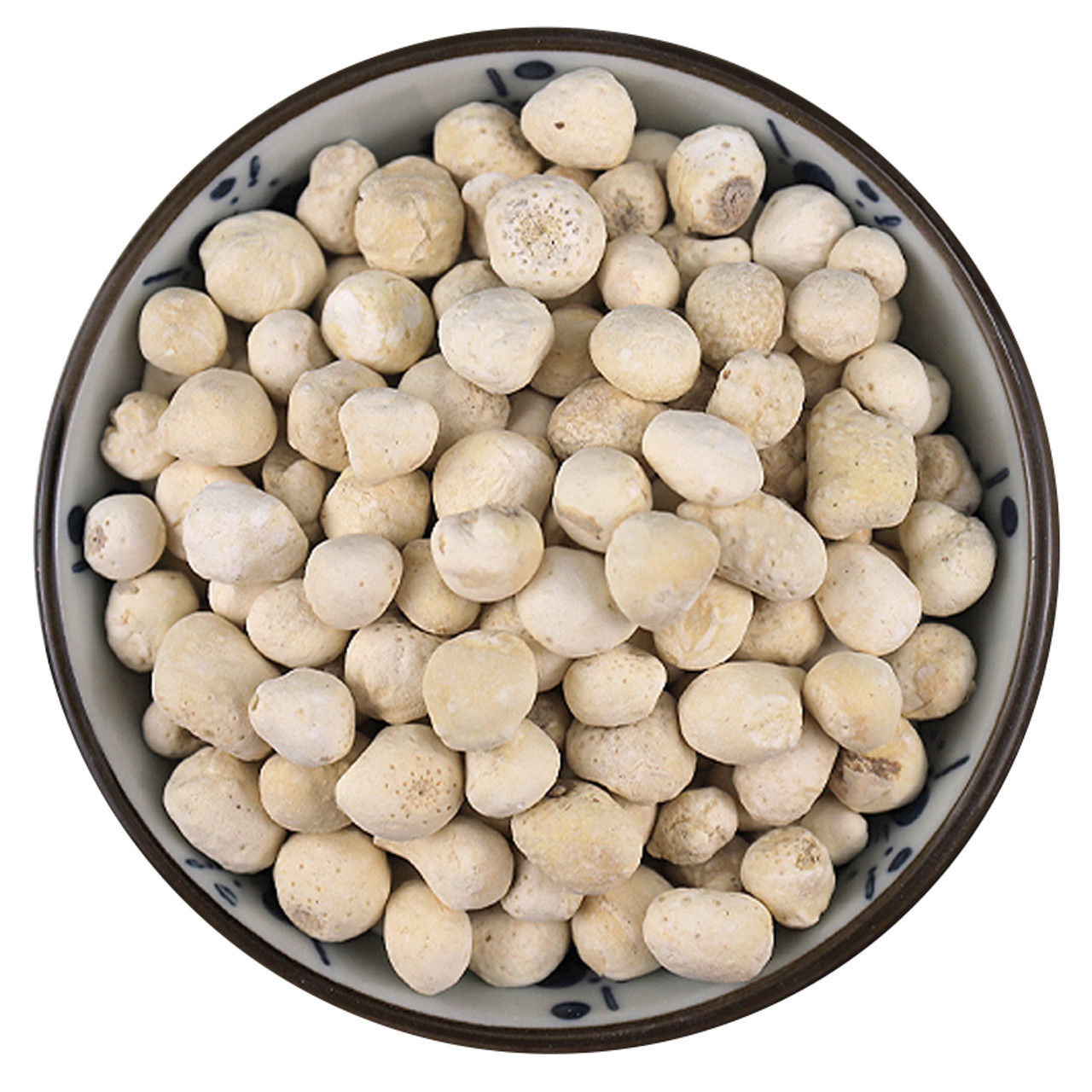

TCM category: Warm herbs that transform Phlegm and stop Cough
TCM nature: Warm
TCM taste(s): Pungent
Meridian affinity: Spleen Stomach Lung
Scientific name: Pinellia ternata
Use of crow-dipper rhizomes in Traditional Chinese Medicine (TCM).
Please note that you should never self-prescribe TCM ingredients. A TCM ingredient is almost never eaten on its own but as part of a formula containing several ingredients that act together. Please consult a professional TCM practitioner, they will be best able to guide you.
Preparation: Because the raw unprocessed herb is toxic, it is most often given in its processed form which is fried with Ginger juice.
Dosage: 3 - 12 grams
Main actions according to TCM*: Drains Dampness and reduces Phlegm. Reverses the flow of Rebellious Qi. Reduces hardenings and relieves distention.
Primary conditions or symptoms for which crow-dipper rhizomes may be prescribed by TCM doctors*: Asthma, Coughing,Phlegm, Sputum, Palpitations, Headache, Morning sickness ,Globus, pharyngis, Chest congestion
Contraindications*: This herb is toxic in its raw form so it should only be taken if processed by a professional. This herb should not be used by pregnant women or those with any blood disorders, especially bleeding. It should be used with caution by those with Heat and Dryness. This herb should not be used with Aconite (Fu Zi).
In Traditional Chinese Medicine (TCM), crow-dipper rhizomes are plants that belong to the 'Warm herbs that transform Phlegm and stop Cough' category. In TCM Phlegm is a condition of Stagnation of Fluids which tends to start in the Spleen and then goes to the Lungs. If this overly accumulates it thickens and becomes pathological Phlegm. Phlegm, being a form of Stagnation, often starts as being Cool and transforms to Hot as the condition progresses. The herbs in this category are Warm in nature so they treat the early stages of the Stagnation: Cold-Phlegm and Wet-Phlegm with symptoms of wheezing, vomiting and nausea.
As suggested by its category crow-dipper rhizomes are plants that are Warm in nature. This means that crow-dipper rhizomes tend to help people who have too much "cold" in their body, although with less effect than a plant that would be Hot in nature. Balance between Yin and Yang is a key health concept in TCM. Those who have too much cold in their body are said to either have a Yin excess (because Yin is Cold in nature) or a Yang deficiency (Yang is Hot in Nature). Depending on your condition crow-dipper rhizomes can help restore a harmonious balance between Yin and Yang.
Crow-dipper rhizomes also taste Pungent. The so-called "five elements" theory in Chinese Medicine states that the taste of TCM ingredients is a key determinant of their action in the body. Pungent ingredients like crow-dipper rhizomes tend to promote the circulations of Qi and body fluids. That's why for instance someone tends to sweat a lot when they eat spicy/pungent food.
The tastes of ingredients in TCM also determine what organs and meridians they target. As such crow-dipper rhizomes are thought to target the Spleen, the Stomach and the Lung. In TCM the Spleen assists with digestion, blood coagulation and fluid metabolism in the body. The Stomach on the other hand is responsible for receiving and ripening ingested food and fluids. It is also tasked with descending the digested elements downwards to the Small Intestine. In addition to performing respiration, the Lungs are thought to be a key part of the production chain for Qi and the body fluids that nourish the body.